
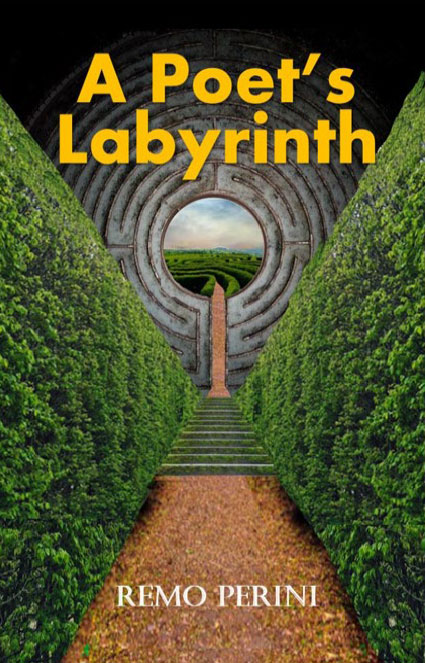
A Labyrinth is a geometric shape that symbolizes human creativity and is representative of a journey. Following quickly on the heels of his debut book of poetry, Evens and Beginnings, A Collection of Odds and Ends, A Poet’s Labyrinth has been a journey of creativity, written and composed in locations spanning the globe in concert with the author’s inner journey. The written word, as an artform, connects well with imagery and both combine to tell the tale of an inner journey, still in progress.
Read an excerpt (PDF).
As for the content of the book, A poet’s Labyrinth is a poignant poetry collection that guides us to an introspective look at life. The author’s mesmerizing verses will strike a chord in your heart and force you that introspection. The author has mastered the art of rhyme, but mixes styles with poems that are experimental, some with non-rhythmic verses and non-traditional structures. Most of the works have clearly discernable topics and subject matter, while others are more abstract. Despite the similar underlying theme of the nature of existence and the exploration of the human condition, every piece feels unique and brings something of its own to the narrative. Poems that require more emotional energy to comprehend are punctuated with less exhausting, perhaps whimsical, but no less entertaining works. The Poet’s Labyrinth delivers and when combined with the imagery selected to accentuate each poem, the result is almost wholly immersive. The imagery complements the poetry and breathes life into the printed words. For example, one unique piece encourages a departure from accepted ideas: “Don’t accept the offered apple unless it contains a worm… The worm is of more interests than the apple. Be the uninvited worm. Break through the shiny surface, and create novel concepts that will change everything." The image accompanying this work is of an apple being injected by hypodermic needle with “prevailing thought”. In Sidewalks & Streets, the author explains that inanimate objects perceive our existence. The lines, “The roof and the walls, the ceilings, and floors, retain the vibrations of lives lived indoors. The doors and the shutters, the windows, and walls, perceive our movements, our heat in their halls.” This work had me start to consider the walls and the floors of my house as perceptive entities. The piece about “Little Boy Blue” is similarly intriguing with the characters from famous paintings discussing their observations of those of us that visit their gallery: "We gaze from where we’re hung. When evening comes we dance and laugh, for we’re forever young". Perhaps the most poignant stanza in the book is the refutation of Robert Frost’s, “The Road not Taken” with the author's observation: “There really is no difference in the paths your life can trace. Our plans and goals and paths and dreams all end in the same place. So better to surround yourself with joy and love and laughter. A trodden path of happiness, before the “ever after.” A Poet’s Labyrinth is a work of beauty that will resonate with your personal experiences by looking at life from an oblique angle. The book is the author’s gift to his readers, and as he says in his playful ode, “Gifts”: "The artist offers selfless acts, as gifts to humankind, Through music, art, and written word, creations of the mind." A work titled, "In The Kitchen" depicts the banjo as an analog for life, ending with the words, "We Listen to Learn, then we Learn to Listen. We look back and Reflect on Long Ago. Through each live-long day, Our soundtrack was played, In the Kitchen on Dinah’s Banjo." The author speaks to us directly in "Touching" by saying, "As you read, some parts of you, Combine with parts of me, Convergence of awareness, A shared realty." If you have read this review to here, you will love The Poet's Labyrinth, and so will your friends.